

Our Services
Facility management digital twin benefits for lower costs
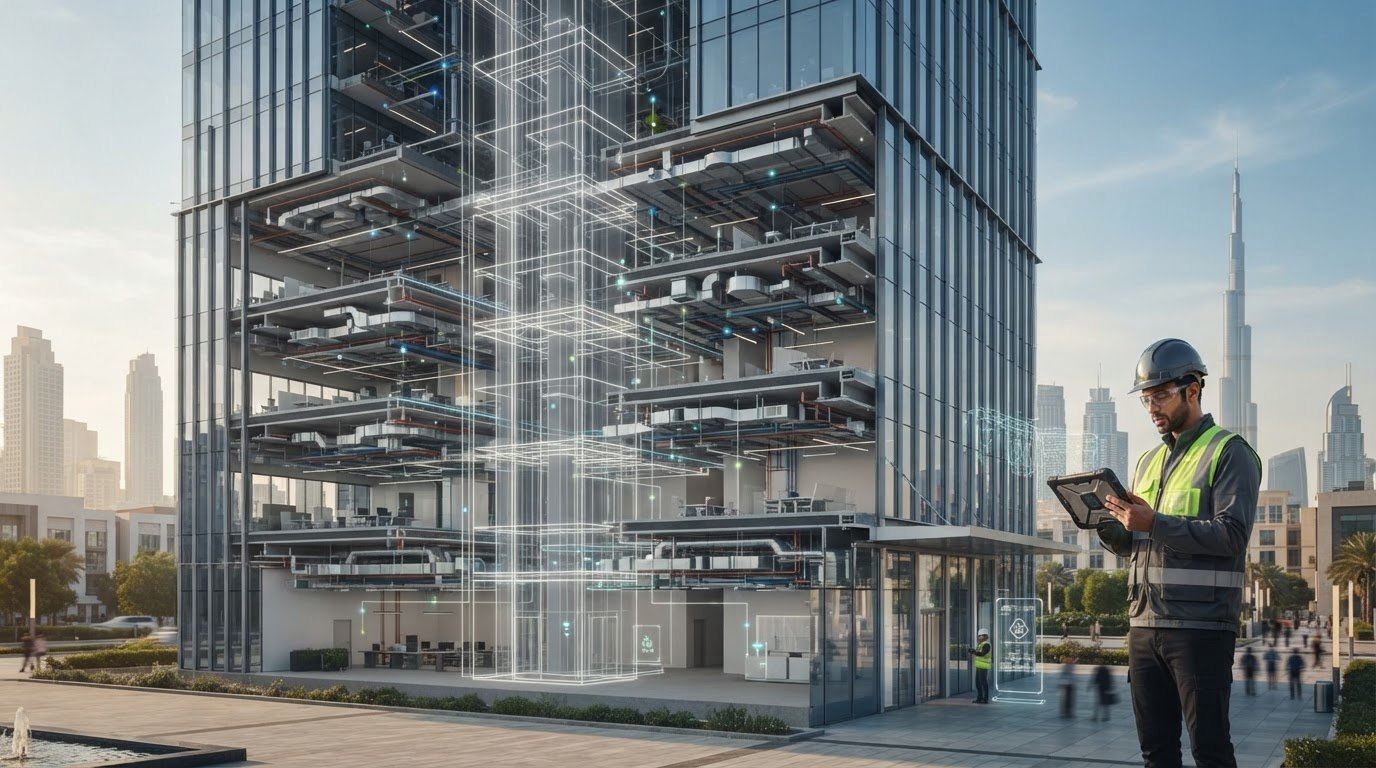
A digital twin is more than a 3D model: it connects a facility’s digital representation with real-time data about assets such as HVAC, plumbing, lighting and electrical systems. For facility teams in the UAE, the benefits of facility management digital twins include better visibility of building operations, support for predictive maintenance and opportunities to reduce energy use and operating costs.
It’s reasonable to ask whether a digital twin will improve day-to-day facility management or simply add another layer of technology. Its value lies in bringing asset information and operational data into a shared view, helping teams identify issues, make informed decisions, and coordinate maintenance.
This article explains how facility digital twins work, how they can support maintenance and operational performance, and how they may help teams review energy use. It also covers EAM, CMMS, and IoT integrations, along with the data and modelling considerations for facilities in Dubai and across the UAE.
Key Takeaways
- Understand how a facility digital twin combines a 3D model with operational data to give teams a clearer view of building assets.
- See how asset condition data can support predictive maintenance and help teams plan interventions before equipment failures disrupt operations.
- Identify how a shared facility view can improve operational decisions, reveal maintenance priorities and support more efficient use of resources.
- Explore how energy data and connected EAM, CMMS and IoT platforms can help link building performance with maintenance workflows.
- Learn when topo survey and other geospatial data can provide a useful foundation for facility planning and digital twin development.
Why should a company invest in digital twins?
A facility digital twin links a detailed 3D representation with live information about the building. Its value depends on connecting trustworthy asset data to decisions facility teams make every day.
Understanding Digital Twins and Real-Time Facility Data
A facility digital twin is a 3D model updated with real-time data from facility systems and sensors. It can bring information about HVAC, plumbing, lighting, and electrical assets into a spatial view. This helps teams locate equipment, see relevant operating conditions, and understand how building systems relate to one another, rather than interpreting data without its physical context.
For example, a temperature reading tied to a specific air-handling unit is more useful than an unlocated value in a spreadsheet. Digital twins can enable real-time monitoring and control of facilities and management processes. Companies using them report asset-utilization improvements of 62%, while reported decision-making cycles are 90% faster.
Consolidating Facility Data for Better Decisions
Consolidating facility data means bringing asset records, locations, maintenance details, and sensor readings into a coordinated view. Facility teams spend nearly 35% of their time searching across disconnected systems. A digital twin can reduce this fragmentation by associating information with the correct space or asset, helping managers understand what needs attention and where.
Geolocated asset records make information easier to use. A technician can select a pump on a floor plan, review its records, and link its location to a work process. QR-code labels can provide a physical reference: scanning a code beside a panel can open its asset record, as long as the code and record remain correctly matched.
Useful decisions depend on good data governance. Assign owners to asset records, use consistent identifiers, log updates, and manage access. These practices help prevent duplicate records, outdated locations, and conflicting information from undermining the model.
Comparing Digital Twins with BIM and Building Systems
BIM organizes building information in a model, often for design and construction. A building management system monitors and controls connected equipment. A digital twin can extend a model into operations by linking spatial information with current facility data.
The distinction matters when teams need more than a design record or equipment-control interface. A model can show where an asset is; connected operational data can show its status. The depth of that connection depends on the available data and system integration.
Creating and Applying Facility Digital Twins
Creating a twin involves assessing the facility, collecting data, building a digital model, integrating systems, training users, and updating the model over time. For an existing building, teams can start with available drawings and asset records, then capture or update spatial information where gaps affect operations.
Required inputs can include a spatial model, asset identifiers, equipment records, and sensor or system data. The technologies depend on the intended uses and may include 3D modelling, sensors, and connections to facility systems.
For facilities in the UAE, applicable building, privacy, cybersecurity, and authority requirements depend on the emirate, facility, and data involved. A digital twin does not replace these obligations. Project teams should account for relevant requirements in their data access and governance practices.
In Dubai and across the UAE, facility teams may use a digital twin to locate assets, coordinate maintenance, and review operating conditions in offices, hotels, malls, and industrial buildings. The use case determines which assets and data to prioritize.
Predictive maintenance and equipment failure prevention
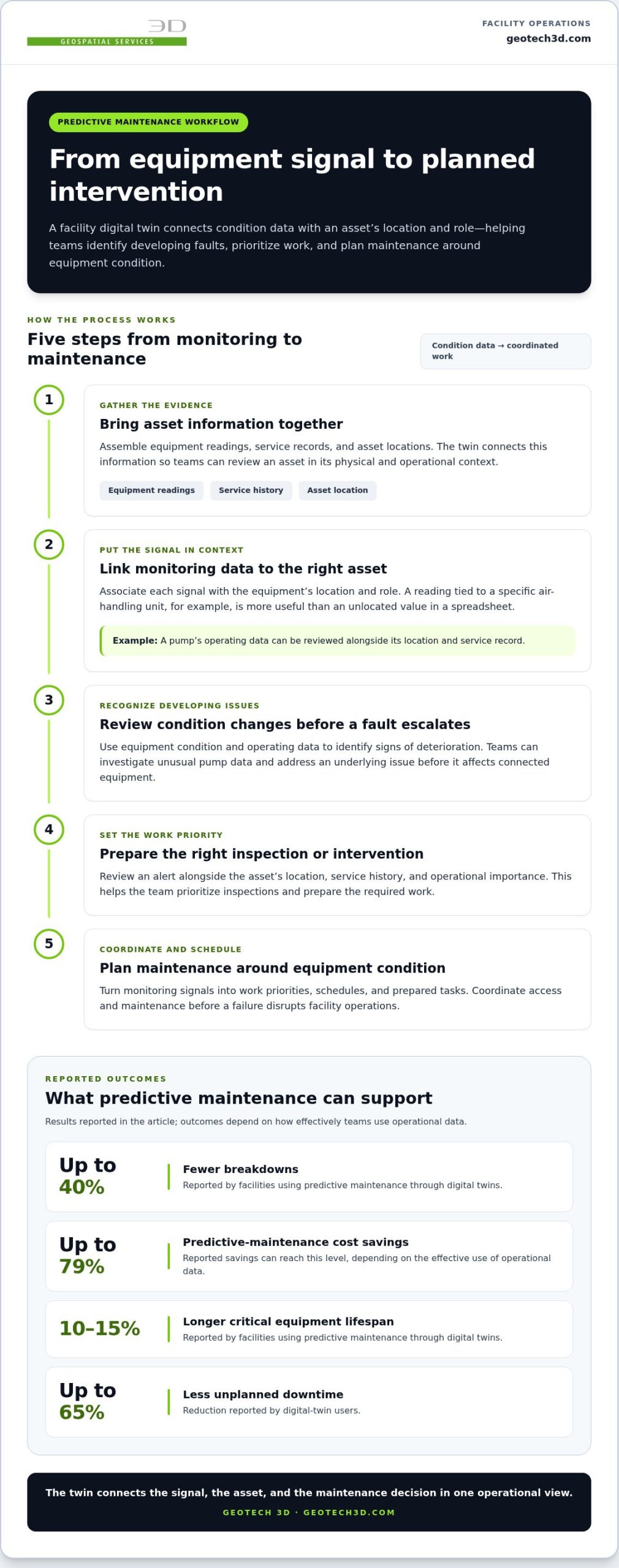
Predictive maintenance uses equipment condition and operating data to identify developing faults before they interrupt facility operations. A digital twin helps teams connect monitoring signals with each asset’s location and role.
Reducing Maintenance Costs and Breakdowns
Condition-based monitoring helps maintenance teams act on signs of deterioration instead of relying only on fixed schedules or emergency repairs. Digital twins can bring equipment readings, service records, and asset locations together, helping teams prioritize inspections and prepare the right intervention. Facilities using predictive maintenance through digital twins report up to 40% fewer breakdowns. Reported predictive-maintenance cost savings can reach up to 79%, depending on how effectively teams use operational data.
Extending Asset Lifespan
Predictive maintenance supports longer asset life by identifying changing performance before a fault causes additional wear. For example, a team monitoring a pump can investigate unusual operating data and address the underlying issue before it affects connected equipment. Facilities using predictive maintenance through digital twins report that critical building equipment lifespan can extend by 10% to 15%. Timely maintenance also helps teams plan interventions around equipment condition rather than replacing assets prematurely.
Planning Maintenance to Reduce Downtime
Maintenance planning turns monitoring signals into work priorities, schedules, and prepared tasks. A team can review an alert alongside an asset’s location, service history, and operational importance, then coordinate access and required work. Digital-twin users report reductions in unplanned downtime of up to 65%. This is particularly relevant when a failure could disrupt other systems, such as an air-handling unit serving occupied areas. Prioritizing by condition and operational impact helps teams focus attention where interruption matters most.
Preventive and Corrective Maintenance
Preventive maintenance is planned to reduce the likelihood of failure; corrective maintenance addresses a fault that has already occurred. A digital twin can support both by connecting maintenance records with asset locations and available condition data. For example, scheduled filter servicing is preventive, while repairing a failed fan is corrective. Predictive monitoring adds another planning signal, helping teams adjust preventive work when equipment conditions warrant attention.
To use predictions responsibly, teams need clear thresholds, reliable asset records, and a process for reviewing alerts. A reading should prompt an inspection or work order only when it makes sense in the asset’s operating context. Teams can compare scenarios, such as a changing vibration pattern against earlier readings, and record whether the finding led to maintenance. That feedback supports better decisions and fewer repeated investigations.
Ownership clarity also affects maintenance planning in shared properties. For facilities with separate units and common areas, real estate strata information can help distinguish responsibilities when teams coordinate work across those spaces.
Return on investment and operational performance
Assess a digital twin investment by connecting its implementation to measurable changes in facility operations. For owners in Dubai and across the UAE, relevant measures depend on existing workflows, resource use, and operational priorities.
Returns Through Operational Performance
Operational return on investment describes the value gained when a digital twin helps improve facility performance. McKinsey research cited by industry analysts indicates digital twins can cut operational costs by up to 15%. This is a potential benchmark, not a guaranteed result for every property. A Dubai facilities team can use its own baseline to evaluate whether changes in work coordination or information access create measurable value.
Set a baseline before implementation. For example, a team managing several buildings could record how often staff revisit spaces to verify asset details, how long work preparation takes, or how frequently tasks are rescheduled. Choose measures that reflect existing records and keep their definitions consistent during review. This gives managers a practical way to assess whether new workflows improve operations.
Operational models can also help managers compare priorities across a portfolio. If one building has incomplete asset records while another has recurring coordination delays, the team can identify where improved information may support a decision first. A defined use case makes investment discussions more precise than relying on a broad claim of efficiency.
Reducing Costs and Resource Waste
Digital twins can support cost control by helping teams identify avoidable effort and resource waste. Digital twins can reduce operating costs by up to 35% in the energy and construction sectors. The result depends on the operational changes made and the facility conditions being addressed, so teams should assess their own performance measures.
For a multi-building portfolio in the UAE, managers could examine whether inconsistent records lead to repeated checks or make it harder to coordinate planned work. Track the relevant process before and after a change, using the same definitions each time. This can show whether a new workflow reduces duplicated effort or shifts it to another team.
Efficiency also depends on adoption. If staff continue to rely on disconnected records, the model may not influence everyday work. Assign responsibility for updating operational information, connect findings to existing procedures, and review whether teams use the model to prepare decisions. These steps keep implementation aligned with facility priorities.
Distinguish measurable operating improvements from assumptions about future savings. Record what changed, which process it affected, and how the result was assessed. This gives managers a clearer basis for deciding whether to maintain or expand the digital twin across Dubai facilities.
Energy efficiency and sustainability
Energy performance improves when facility teams connect building conditions with energy data and operational choices. A digital twin supports that analysis by showing where energy is used and how systems respond to changes. Digital twins can reduce building energy consumption by up to 20%; reported reductions reach up to 50% in the energy and construction sectors. These figures describe potential outcomes, not a fixed result for every facility.
For a Dubai office building, teams could review HVAC operation alongside room conditions, equipment schedules, and available energy readings. The virtual model provides spatial context for complex systems, while operational data can point to areas for further analysis. For example, a team could compare energy use in two similar zones and investigate whether differences relate to operating hours, occupancy, or equipment performance. Facility management digital twin benefits become practical when data informs a clear operational decision.
Useful energy analysis starts with a clear baseline. Facility managers can organize records by building, floor, zone, or system, then examine how consumption changes under different operating conditions. They can explore scenarios such as adjusting schedules or reviewing how a system responds to changing occupancy. These comparisons help teams assess a potential operational change before applying it across the facility.
- System view: Relate energy readings to HVAC equipment, lighting, and the spaces they serve.
- Time view: Compare consumption across operating periods using consistent records.
- Scenario view: Assess how a proposed schedule or operating adjustment could affect building performance.
These steps make sustainability decisions more specific. A high reading in one zone may call for reviewing its schedule or connected equipment, rather than making a building-wide change. Teams can document the issue, action taken, and subsequent readings. This record helps distinguish an effective adjustment from one that simply shifts energy use elsewhere.
In a complex facility, data quality affects every comparison. Teams need consistent asset names, clear locations, and energy records linked to the correct systems and periods. If a meter serves several areas, its readings need context before teams draw conclusions about one zone. Regular reviews can flag missing or mismatched information before it informs an operational decision.
For sustainability reporting, a digital twin can connect building spaces, systems, and performance observations in a structured way. Facility teams can use this view to prioritize investigations, track operational changes, and explain the basis for decisions. Facility management digital twin benefits are strongest when relevant data leads to targeted action and measurable energy monitoring.
Integration with EAM, CMMS, and IoT platforms
A digital twin becomes more useful when its spatial asset model connects to operational platforms. EAM, CMMS, and IoT systems each contribute different information: EAM supports enterprise asset management, a CMMS organizes maintenance work, and IoT sensors provide readings from connected equipment. Integration can link these records to asset locations, giving facility teams a more complete operational view.
For example, a technician viewing an air-handling unit in a 3D model could access its asset record and maintenance history. A CMMS may hold work orders, while an EAM may organize asset information across a portfolio. The digital twin can provide spatial context for those records. Teams can then discover which equipment needs attention and where it sits within the building.
IoT data adds operating context. A sensor reading linked to a pump or electrical panel can help teams review equipment status alongside its location and service information. The key is not simply displaying a reading, but matching the correct sensor, asset identifier, location, and time so staff understand what the data represents.
- Spatial model: Shows asset locations, rooms, floors, and their relationships.
- EAM or CMMS: Connects asset records, work orders, and maintenance history.
- IoT platform: Supplies sensor readings that can provide operational context.
Before integrating systems, define which information should move between them and which system owns each record. An asset identifier, for example, should match across the model and maintenance platform. If a pump is renamed in one system but not another, staff may see duplicate or disconnected information. Clear ownership and consistent identifiers make the integrated view more dependable.
Choose a model format that can work with the facility-management software and systems in use. The integration design should also reflect whether the building team needs portfolio management, location-based asset tracking, or preventive and corrective maintenance workflows. Combining a 3D twin with web-based facilities-management software can improve transparency and productivity while supporting cost reduction.
In CAFM or IWMS environments, a twin can provide a spatial interface to building operations and facility information. Its value depends on how well asset data, locations, and workflows align. Start with a defined use case, such as locating equipment before maintenance, then expand connections as teams incorporate the information into existing processes.
For connected facility data and spatial asset context, discuss your project requirements with GEOTECH 3D.
GEOTECH 3D: topo survey
GEOTECH 3D provides topo survey services for projects that need accurate site context. A topographic survey records surface features and elevation, giving facility teams a measured spatial reference for planning and asset coordination.
For a facility digital twin, site information can help relate building footprints, external assets, access routes, and surrounding terrain. This is useful when an existing site model needs to reflect current conditions or when facility planning extends beyond the building interior. GEOTECH 3D also offers 3D Laser Scanning, Drone Services, and GIS & Surveying Services to support different spatial data requirements.
Contact GEOTECH 3D to discuss topo survey requirements for your facility project.
Turn facility data into a focused next step
Start with an operational priority, such as improving asset visibility, coordinating maintenance, or understanding energy performance. Define what information the team needs, who will use it, and how it should support a decision. This keeps the digital twin focused on facility outcomes rather than treating the model as an end in itself.
To make facility management digital twin benefits practical, assess the quality of existing building and site information. GEOTECH 3D offers topo survey, 3D Laser Scanning, and Drone Services to support spatial data needs for facility projects. These services can help establish the measured context that teams use to plan and develop digital representations.
A clear scope helps stakeholders decide what to model, which data to connect, and where to begin. With a defined use case, your team can move from exploring the concept to planning a purposeful implementation.
Take the next step by defining your facility priorities and building a digital foundation around them.
Frequently Asked Questions
What is a Digital Twin?
A digital twin is a digital representation of a real-world asset or system, connected to information about its physical counterpart. A building twin, for example, can show spaces, equipment, and operational records in one interface. Its purpose depends on the task: a design team may use it to understand building configuration, while an operations team may use it to support facility decisions.
How will future facility management differ from today?
Facility management is likely to rely increasingly on connected information rather than manually reconciling separate records. A manager could review an issue alongside its location, equipment history, and related work records, then coordinate a response with relevant teams. This changes how staff access and use information, while human judgment remains essential to setting priorities and choosing appropriate actions.
What is a digital twin in facility management?
A facility management digital twin applies digital-twin methods to a building and its operational needs. It can represent spaces and assets while connecting information used by facility teams. For example, a property manager reviewing a tenant-area issue could use a spatial view to locate the affected part of the building and identify related records before coordinating follow-up.
What are the main benefits of digital twins for facility management?
The main benefits are clearer asset visibility, better-connected information, and stronger support for operational planning. A portfolio manager can use a consistent view to compare building information, while an on-site team can focus on a specific room or system. Value depends on whether the twin helps users complete practical tasks, such as preparing a handover or reviewing an asset-related issue.
How do digital twins reduce facility operating and maintenance costs?
Digital twins can support cost control by helping teams identify avoidable effort and plan work using connected building information. Before dispatching staff, for instance, a coordinator can review an issue’s location and available records to prepare the visit. Teams can also examine recurring work patterns and resource use, then target process changes where evidence points to repeated inefficiencies.
How do digital twins improve energy efficiency and sustainability in buildings?
Digital twins help teams examine energy performance in relation to building spaces and systems. A facilities team could compare readings across zones, then investigate whether schedules or system settings explain the variation. Recording the baseline, operational adjustment, and later readings provides a clearer basis for evaluating the action. This supports targeted reviews instead of general assumptions about building-wide performance.
How do digital twins support predictive maintenance and reduce equipment downtime?
Digital twins support predictive maintenance by linking equipment information with condition data and operational context. If a monitoring system flags an unusual reading, staff can identify the asset, review its service information, and decide on an appropriate inspection or maintenance action. This helps teams prioritize investigation and coordinate access, parts, and responsibilities before an equipment issue interrupts facility operations.
What are the typical costs and ROI of facility management digital twins?
There is no single typical cost for a facility digital twin because scope varies. Cost factors include the building information available, required spatial detail, data preparation, platform capabilities, and necessary integrations. To evaluate return on investment, establish operating baselines before implementation and track relevant outcomes afterward, such as staff time spent locating records, site visits, or maintenance coordination. Project pricing depends on scope and is provided after a quote request.
A digital twin is more than a 3D model: it connects a facility’s digital representation with real-time data about assets such as HVAC, plumbing, lighting and electrical systems. For facility teams in the UAE, the benefits of facility management digital twins include better visibility of building operations, support for predictive maintenance and opportunities to reduce energy use and operating costs.
It’s reasonable to ask whether a digital twin will improve day-to-day facility management or simply add another layer of technology. Its value lies in bringing asset information and operational data into a shared view, helping teams identify issues, make informed decisions, and coordinate maintenance.
This article explains how facility digital twins work, how they can support maintenance and operational performance, and how they may help teams review energy use. It also covers EAM, CMMS, and IoT integrations, along with the data and modelling considerations for facilities in Dubai and across the UAE.
Key Takeaways
- Understand how a facility digital twin combines a 3D model with operational data to give teams a clearer view of building assets.
- See how asset condition data can support predictive maintenance and help teams plan interventions before equipment failures disrupt operations.
- Identify how a shared facility view can improve operational decisions, reveal maintenance priorities and support more efficient use of resources.
- Explore how energy data and connected EAM, CMMS and IoT platforms can help link building performance with maintenance workflows.
- Learn when topo survey and other geospatial data can provide a useful foundation for facility planning and digital twin development.
Why should a company invest in digital twins?
A facility digital twin links a detailed 3D representation with live information about the building. Its value depends on connecting trustworthy asset data to decisions facility teams make every day.
Understanding Digital Twins and Real-Time Facility Data
A facility digital twin is a 3D model updated with real-time data from facility systems and sensors. It can bring information about HVAC, plumbing, lighting, and electrical assets into a spatial view. This helps teams locate equipment, see relevant operating conditions, and understand how building systems relate to one another, rather than interpreting data without its physical context.
For example, a temperature reading tied to a specific air-handling unit is more useful than an unlocated value in a spreadsheet. Digital twins can enable real-time monitoring and control of facilities and management processes. Companies using them report asset-utilization improvements of 62%, while reported decision-making cycles are 90% faster.
Consolidating Facility Data for Better Decisions
Consolidating facility data means bringing asset records, locations, maintenance details, and sensor readings into a coordinated view. Facility teams spend nearly 35% of their time searching across disconnected systems. A digital twin can reduce this fragmentation by associating information with the correct space or asset, helping managers understand what needs attention and where.
Geolocated asset records make information easier to use. A technician can select a pump on a floor plan, review its records, and link its location to a work process. QR-code labels can provide a physical reference: scanning a code beside a panel can open its asset record, as long as the code and record remain correctly matched.
Useful decisions depend on good data governance. Assign owners to asset records, use consistent identifiers, log updates, and manage access. These practices help prevent duplicate records, outdated locations, and conflicting information from undermining the model.
Comparing Digital Twins with BIM and Building Systems
BIM organizes building information in a model, often for design and construction. A building management system monitors and controls connected equipment. A digital twin can extend a model into operations by linking spatial information with current facility data.
The distinction matters when teams need more than a design record or equipment-control interface. A model can show where an asset is; connected operational data can show its status. The depth of that connection depends on the available data and system integration.
Creating and Applying Facility Digital Twins
Creating a twin involves assessing the facility, collecting data, building a digital model, integrating systems, training users, and updating the model over time. For an existing building, teams can start with available drawings and asset records, then capture or update spatial information where gaps affect operations.
Required inputs can include a spatial model, asset identifiers, equipment records, and sensor or system data. The technologies depend on the intended uses and may include 3D modelling, sensors, and connections to facility systems.
For facilities in the UAE, applicable building, privacy, cybersecurity, and authority requirements depend on the emirate, facility, and data involved. A digital twin does not replace these obligations. Project teams should account for relevant requirements in their data access and governance practices.
Predictive maintenance and equipment failure prevention
Predictive maintenance uses equipment condition and operating data to identify developing faults before they interrupt facility operations. A digital twin helps teams connect monitoring signals with each asset’s location and role.
Reducing Maintenance Costs and Breakdowns
Condition-based monitoring helps maintenance teams act on signs of deterioration instead of relying only on fixed schedules or emergency repairs. Digital twins can bring equipment readings, service records, and asset locations together, helping teams prioritize inspections and prepare the right intervention. Facilities using predictive maintenance through digital twins report up to 40% fewer breakdowns. Reported predictive-maintenance cost savings can reach up to 79%, depending on how effectively teams use operational data.
Extending Asset Lifespan
Planning Maintenance to Reduce Downtime
Preventive and Corrective Maintenance
To use predictions responsibly, teams need clear thresholds, reliable asset records, and a process for reviewing alerts. A reading should prompt an inspection or work order only when it makes sense in the asset’s operating context. Teams can compare scenarios, such as a changing vibration pattern against earlier readings, and record whether the finding led to maintenance. That feedback supports better decisions and fewer repeated investigations.
Ownership clarity also affects maintenance planning in shared properties. For facilities with separate units and common areas, real estate strata information can help distinguish responsibilities when teams coordinate work across those spaces.
Return on investment and operational performance
Assess a digital twin investment by connecting its implementation to measurable changes in facility operations. For owners in Dubai and across the UAE, relevant measures depend on existing workflows, resource use, and operational priorities.
Returns Through Operational Performance
Operational return on investment describes the value gained when a digital twin helps improve facility performance. McKinsey research cited by industry analysts indicates digital twins can cut operational costs by up to 15%. This is a potential benchmark, not a guaranteed result for every property. A Dubai facilities team can use its own baseline to evaluate whether changes in work coordination or information access create measurable value.
Set a baseline before implementation. For example, a team managing several buildings could record how often staff revisit spaces to verify asset details, how long work preparation takes, or how frequently tasks are rescheduled. Choose measures that reflect existing records and keep their definitions consistent during review. This gives managers a practical way to assess whether new workflows improve operations.
Operational models can also help managers compare priorities across a portfolio. If one building has incomplete asset records while another has recurring coordination delays, the team can identify where improved information may support a decision first. A defined use case makes investment discussions more precise than relying on a broad claim of efficiency.
Reducing Costs and Resource Waste
Digital twins can support cost control by helping teams identify avoidable effort and resource waste. Digital twins can reduce operating costs by up to 35% in the energy and construction sectors. The result depends on the operational changes made and the facility conditions being addressed, so teams should assess their own performance measures.
For a multi-building portfolio in the UAE, managers could examine whether inconsistent records lead to repeated checks or make it harder to coordinate planned work. Track the relevant process before and after a change, using the same definitions each time. This can show whether a new workflow reduces duplicated effort or shifts it to another team.
Efficiency also depends on adoption. If staff continue to rely on disconnected records, the model may not influence everyday work. Assign responsibility for updating operational information, connect findings to existing procedures, and review whether teams use the model to prepare decisions. These steps keep implementation aligned with facility priorities.
Distinguish measurable operating improvements from assumptions about future savings. Record what changed, which process it affected, and how the result was assessed. This gives managers a clearer basis for deciding whether to maintain or expand the digital twin across Dubai facilities.
Energy efficiency and sustainability
Energy performance improves when facility teams connect building conditions with energy data and operational choices. A digital twin supports that analysis by showing where energy is used and how systems respond to changes. Digital twins can reduce building energy consumption by up to 20%; reported reductions reach up to 50% in the energy and construction sectors. These figures describe potential outcomes, not a fixed result for every facility.
For a Dubai office building, teams could review HVAC operation alongside room conditions, equipment schedules, and available energy readings. The virtual model provides spatial context for complex systems, while operational data can point to areas for further analysis. For example, a team could compare energy use in two similar zones and investigate whether differences relate to operating hours, occupancy, or equipment performance. Facility management digital twin benefits become practical when data informs a clear operational decision.
Useful energy analysis starts with a clear baseline. Facility managers can organize records by building, floor, zone, or system, then examine how consumption changes under different operating conditions. They can explore scenarios such as adjusting schedules or reviewing how a system responds to changing occupancy. These comparisons help teams assess a potential operational change before applying it across the facility.
- System view: Relate energy readings to HVAC equipment, lighting, and the spaces they serve.
- Time view: Compare consumption across operating periods using consistent records.
- Scenario view: Assess how a proposed schedule or operating adjustment could affect building performance.
These steps make sustainability decisions more specific. A high reading in one zone may call for reviewing its schedule or connected equipment, rather than making a building-wide change. Teams can document the issue, action taken, and subsequent readings. This record helps distinguish an effective adjustment from one that simply shifts energy use elsewhere.
In a complex facility, data quality affects every comparison. Teams need consistent asset names, clear locations, and energy records linked to the correct systems and periods. If a meter serves several areas, its readings need context before teams draw conclusions about one zone. Regular reviews can flag missing or mismatched information before it informs an operational decision.
For sustainability reporting, a digital twin can connect building spaces, systems, and performance observations in a structured way. Facility teams can use this view to prioritize investigations, track operational changes, and explain the basis for decisions. Facility management digital twin benefits are strongest when relevant data leads to targeted action and measurable energy monitoring.
Integration with EAM, CMMS, and IoT platforms
A digital twin becomes more useful when its spatial asset model connects to operational platforms. EAM, CMMS, and IoT systems each contribute different information: EAM supports enterprise asset management, a CMMS organizes maintenance work, and IoT sensors provide readings from connected equipment. Integration can link these records to asset locations, giving facility teams a more complete operational view.
For example, a technician viewing an air-handling unit in a 3D model could access its asset record and maintenance history. A CMMS may hold work orders, while an EAM may organize asset information across a portfolio. The digital twin can provide spatial context for those records. Teams can then discover which equipment needs attention and where it sits within the building.
IoT data adds operating context. A sensor reading linked to a pump or electrical panel can help teams review equipment status alongside its location and service information. The key is not simply displaying a reading, but matching the correct sensor, asset identifier, location, and time so staff understand what the data represents.
- Spatial model: Shows asset locations, rooms, floors, and their relationships.
- EAM or CMMS: Connects asset records, work orders, and maintenance history.
- IoT platform: Supplies sensor readings that can provide operational context.
Before integrating systems, define which information should move between them and which system owns each record. An asset identifier, for example, should match across the model and maintenance platform. If a pump is renamed in one system but not another, staff may see duplicate or disconnected information. Clear ownership and consistent identifiers make the integrated view more dependable.
Choose a model format that can work with the facility-management software and systems in use. The integration design should also reflect whether the building team needs portfolio management, location-based asset tracking, or preventive and corrective maintenance workflows. Combining a 3D twin with web-based facilities-management software can improve transparency and productivity while supporting cost reduction.
In CAFM or IWMS environments, a twin can provide a spatial interface to building operations and facility information. Its value depends on how well asset data, locations, and workflows align. Start with a defined use case, such as locating equipment before maintenance, then expand connections as teams incorporate the information into existing processes.
For connected facility data and spatial asset context, discuss your project requirements with GEOTECH 3D.
GEOTECH 3D: topo survey
GEOTECH 3D provides topo survey services for projects that need accurate site context. A topographic survey records surface features and elevation, giving facility teams a measured spatial reference for planning and asset coordination.
For a facility digital twin, site information can help relate building footprints, external assets, access routes, and surrounding terrain. This is useful when an existing site model needs to reflect current conditions or when facility planning extends beyond the building interior. GEOTECH 3D also offers 3D Laser Scanning, Drone Services, and GIS & Surveying Services to support different spatial data requirements.
Turn facility data into a focused next step
Start with an operational priority, such as improving asset visibility, coordinating maintenance, or understanding energy performance. Define what information the team needs, who will use it, and how it should support a decision. This keeps the digital twin focused on facility outcomes rather than treating the model as an end in itself.
To make facility management digital twin benefits practical, assess the quality of existing building and site information. GEOTECH 3D offers topo survey, 3D Laser Scanning, and Drone Services to support spatial data needs for facility projects. These services can help establish the measured context that teams use to plan and develop digital representations.
A clear scope helps stakeholders decide what to model, which data to connect, and where to begin. With a defined use case, your team can move from exploring the concept to planning a purposeful implementation.
Take the next step by defining your facility priorities and building a digital foundation around them.
Frequently Asked Questions
What is a Digital Twin?
A digital twin is a digital representation of a real-world asset or system, connected to information about its physical counterpart. A building twin, for example, can show spaces, equipment, and operational records in one interface. Its purpose depends on the task: a design team may use it to understand building configuration, while an operations team may use it to support facility decisions.
How will future facility management differ from today?
Facility management is likely to rely increasingly on connected information rather than manually reconciling separate records. A manager could review an issue alongside its location, equipment history, and related work records, then coordinate a response with relevant teams. This changes how staff access and use information, while human judgment remains essential to setting priorities and choosing appropriate actions.
What is a digital twin in facility management?
A facility management digital twin applies digital-twin methods to a building and its operational needs. It can represent spaces and assets while connecting information used by facility teams. For example, a property manager reviewing a tenant-area issue could use a spatial view to locate the affected part of the building and identify related records before coordinating follow-up.
What are the main benefits of digital twins for facility management?
The main benefits are clearer asset visibility, better-connected information, and stronger support for operational planning. A portfolio manager can use a consistent view to compare building information, while an on-site team can focus on a specific room or system. Value depends on whether the twin helps users complete practical tasks, such as preparing a handover or reviewing an asset-related issue.
How do digital twins reduce facility operating and maintenance costs?
Digital twins can support cost control by helping teams identify avoidable effort and plan work using connected building information. Before dispatching staff, for instance, a coordinator can review an issue’s location and available records to prepare the visit. Teams can also examine recurring work patterns and resource use, then target process changes where evidence points to repeated inefficiencies.
How do digital twins improve energy efficiency and sustainability in buildings?
Digital twins help teams examine energy performance in relation to building spaces and systems. A facilities team could compare readings across zones, then investigate whether schedules or system settings explain the variation. Recording the baseline, operational adjustment, and later readings provides a clearer basis for evaluating the action. This supports targeted reviews instead of general assumptions about building-wide performance.
How do digital twins support predictive maintenance and reduce equipment downtime?
Digital twins support predictive maintenance by linking equipment information with condition data and operational context. If a monitoring system flags an unusual reading, staff can identify the asset, review its service information, and decide on an appropriate inspection or maintenance action. This helps teams prioritize investigation and coordinate access, parts, and responsibilities before an equipment issue interrupts facility operations.
What are the typical costs and ROI of facility management digital twins?
There is no single typical cost for a facility digital twin because scope varies. Cost factors include the building information available, required spatial detail, data preparation, platform capabilities, and necessary integrations. To evaluate return on investment, establish operating baselines before implementation and track relevant outcomes afterward, such as staff time spent locating records, site visits, or maintenance coordination. Project pricing depends on scope and is provided after a quote request.
Search Now
Error: Contact form not found.